Keeping your hands safe is important, especially at worksites where physical impact is a threat. Safety gloves are your first line of defense against abrasions, cuts, tears, and punctures. But with so many gloves on the market, it can be difficult to understand which glove suits your needs.
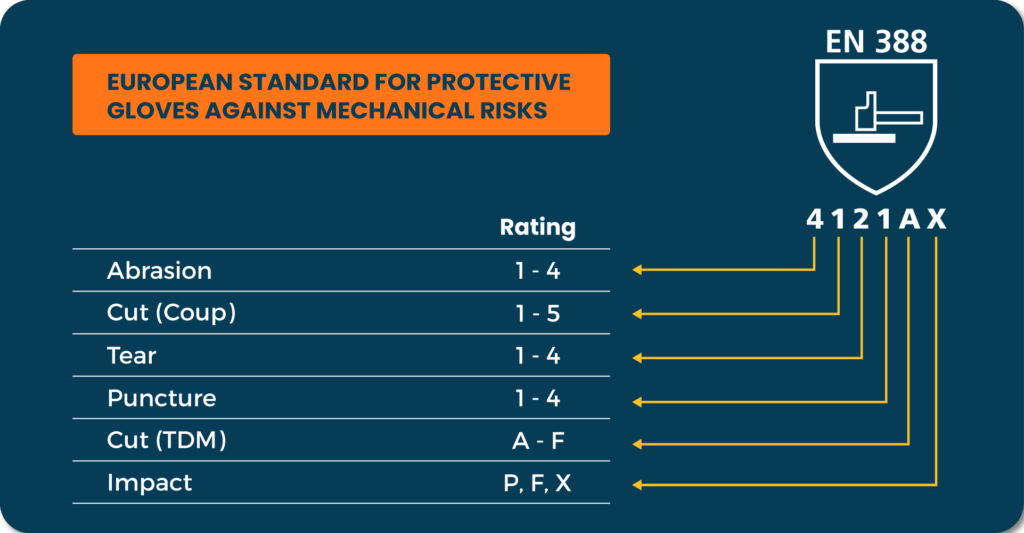
That’s where the EN388 standard comes in. EN388 is the European standard for protective gloves against mechanical risks. It provides a clear, universal way of comparing glove performance across several categories. If you’ve ever noticed a code like 4 3 4 2 F P on the back of a glove, here’s how to read it.
The Six Tests of EN388
EN388 ratings are broken down into six categories, each one represented by a number or letter:
- Abrasion Resistance (1-4)
This measures how well a glove withstands wear and tear from rubbing against surfaces. A higher score means the glove material lasts longer under abrasive conditions, like handling rough tools or materials.
- Cut Resistance – Coup Test (1-5)
This test measures resistance against cuts from a rotating circular blade under constant pressure. A higher number means better protection. However, for high-cut-resistant materials, this test becomes less reliable, which is where the TDM test (see below) comes in.
- Tear Resistance (1-4)
This shows how well a glove can withstand being pulled apart under tension. A glove with a higher tear score is less likely to rip during demanding work.
- Puncture Resistance (1-4)
This measures resistance to penetration by sharp objects such as nails, wire, or splinters. The higher the number, the better the glove protects against punctures.
- TDM Cut Resistance (A-F)
Also called the ISO 13997 test, this measures resistance to cuts from a straight blade under increasing pressure. The ratings range from A (lowest) to F (highest). This test is particularly useful for industries where workers handle sheet metal, glass, or other high-risk materials.
- Impact Protection (P)
If a glove has passed this optional impact protection testing, you’ll see a “P” at the end of the code. This is especially important in industries where heavy tools, machinery, or materials pose a risk of impact injury. F indicates a fail in test while X means not tested.

Example of EN388 Rating
Take the example: EN388: 4 3 4 2 F P
Abrasion: 4 (maximum resistance)
Cut (Coup Test): 3
Tear: 4 (high resistance)
Puncture: 2
TDM Cut: F (very high cut protection)
Impact: P (passed impact test)
This glove would be suitable for high-risk environments such as construction, offshore work, or heavy manufacturing, where both cut and impact protection are critical.
Why EN388 Matters
The EN388 standard takes the guesswork out of choosing gloves. Instead of relying on marketing claims, you can compare objective test results. For employers, this means ensuring compliance, reducing injury risks, and giving workers confidence in their PPE. For workers, it means knowing your gloves are truly up to the task.
Choosing the Right Glove
Not every task requires the maximum rating in all categories. The key is to match glove performance to the hazards of your work:
- Warehouse and logistics – Focus on abrasion and tear resistance.
- Construction and maintenance – Balance between cut and puncture resistance.
- Marine and offshore – Look for strong abrasion, tear, and impact ratings.
- Metal and glass handling – Prioritise high cut resistance (TDM E or F).
At United Resources, we work with leading global PPE brands to supply gloves that meet EN388 standards across industries. Whether you need lightweight general-use gloves or specialised protection for high-risk environments, we help you select the right solution.